
Table of Contents
ToggleIf you’ve ever spent a Sunday scrubbing your car with a bucket and still found mud in the wheel arches, you already know why people buy a water pressure machine. It does in ten minutes what a hose and a sponge can’t do in an hour.
But here’s the thing. Walk into any shop or scroll any website and you’ll see a hundred models, all shouting different numbers. Bar, PSI, LPM, kW. Induction, universal, brass head. It gets confusing fast, and a wrong choice means a machine that either doesn’t clean properly or dies in six months.
So we wrote this guide the way we’d explain it to a friend. No fluff. We’ll cover what a water pressure machine is, how to pick one for your car, your home or your business, what it should cost, and what to avoid.
What Is a Water Pressure Machine?
A water pressure machine, also called a pressure washer or high pressure washer, is a cleaning machine that squeezes ordinary tap water into a powerful, narrow jet. A motor drives a pump, the pump builds up pressure, and the water comes out of the nozzle fast enough to blast off mud, grease, algae, oil and old paint.
Think of it this way: a garden hose pours water on dirt. A water pressure machine hits dirt with water. That difference in force is what lifts the grime instead of just wetting it.
People use them for:
- Washing cars, bikes and scooters
- Cleaning driveways, patios, terraces and boundary walls
- Washing tractors, trucks and farm equipment
- Degreasing workshop floors and machinery
- Cleaning shopfronts, shutters and tiles
- Pre-painting surface prep
And here’s something most people don’t realise: a good water pressure machine often uses less water than a hose. A hose runs at around 15-20 litres a minute. A typical machine uses 6-8. You finish faster and use less.
How Does a Water Pressure Machine Work?
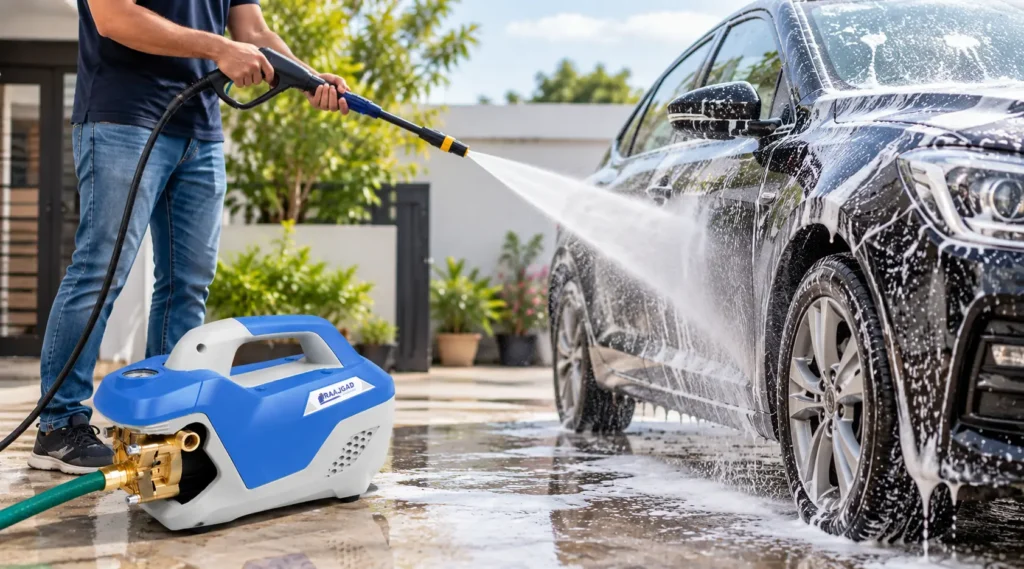
It sounds technical, but it’s pretty simple. Four parts do all the work.
The motor. This is the power source. It’s either electric or petrol.
The pump. The motor drives the pump, which compresses the incoming water to a high pressure. This is the heart of the machine. A good pump is the single biggest reason one machine lasts five years and another lasts five months.
The high-pressure hose and gun. This carries pressurised water from the machine to your hand. You squeeze the trigger, water flows. Release it, and a good machine shuts the motor off automatically.
The nozzle. This is where the magic happens. A narrow nozzle angle (0° or 15°) gives a hard, tight jet for stubborn dirt. A wide angle (25° or 40°) gives a gentler fan, which is what you want for cars.
Add detergent through a soap bottle or foam cannon, let it sit for a minute or two, and rinse. That’s the whole process.
Which Water Pressure Machine Suits You?
| Your situation | Pressure (bar) | Flow (LPM) | Motor | What we’d suggest |
|---|---|---|---|---|
| Washing a car or bike at home | 100-130 | 5-7 | Electric | Entry to mid-range, with foam cannon |
| Home cleaning: balcony, patio, walls | 110-150 | 6-8 | Electric (induction) | Mid-range, add a surface cleaner |
| Large driveway or compound | 140-170 | 7-9 | Electric or petrol | Premium electric or petrol |
| Small garage or car wash business | 130-180 | 8-12 | Induction or 3-phase | Commercial-grade, continuous duty |
| Farm or no power supply | 150-250 | 9-15 | Petrol | Petrol, wheeled frame |
| Heavy grease or industrial | 150-250+ | 10-20 | 3-phase or hot water | Hot water commercial unit |
If you’re buying for your car
A lot of first-time buyers make the same mistake: they think more pressure is always better. For a car, it isn’t. Anything beyond about 130 bar and you risk lifting paint edges, damaging rubber seals or pushing water into places it shouldn’t go. A 100-130 bar water pressure machine with a foam cannon is the sweet spot.
If you’re buying for your home
You’ll probably do a mix: car on weekends, balcony and terrace a few times a year, and maybe the boundary wall before a festival. A mid-range 110-150 bar induction model covers all of it without being overkill.
If you’re buying for a business
Don’t buy a domestic machine and expect it to survive daily commercial use. It won’t. You need a continuous-duty rated machine with a proper pump (look for brass or stainless heads and a triplex pump on higher models). It costs more upfront and saves a lot in repairs and downtime.
Electric vs Petrol Water Pressure Machine: Which One?
Let’s settle this simply.
Choose electric if you’ve got a power socket nearby, you want something quiet and easy, and your work is cars, homes or garages. For most buyers, this is the answer.
Choose petrol if you’ve got no electricity where you’re working, or you need very high pressure and flow, like on a farm or a construction site.
| Features | Electric | Petrol |
|---|---|---|
| Pressure range | 100-170 bar | 150-250+ bar |
| Noise | Low to moderate | Loud |
| Maintenance | Very little | Engine oil, fuel, plugs |
| Running cost | Low | Higher |
| Needs a power socket? | Yes | No |
| Fumes | None | Yes, outdoor use only |
| Best for | Car, home, garage | Farm, site, heavy work |
How to Spot a Good Brand (and a Bad One)
Before you pay, run through this quick check.
- Is the warranty clear? Look for how long it is, what it covers (motor, pump, gun) and how claims actually work.
- Can you get service and spares? A machine without spare parts support becomes a paperweight the first time a seal wears out.
- Are the specs real? The rated bar, LPM and kW should be printed on the machine, not just on the box.
- What’s inside? Copper-wound induction motors and brass pump heads are good signs.
- Are the reviews genuine? Look for detailed reviews with photos or videos, not just five-star ratings with no comments.
- Can you talk to a person? A seller who answers questions properly before the sale is likely to help after it, too.
At RAAJGAD TECHNO SERVICES PVT. LTD., every water pressure machine comes with WARRANTY, genuine spare parts, a proper tax invoice and a real human you can call or WhatsApp at – +91 99231 01807
How to Use a Water Pressure Machine Without Damaging Anything
A pressure washer is a tool, not a toy. Used well, it’s brilliant. Used carelessly, it can strip paint, gouge wood or cut skin. Here’s how to do it right.
Step by step
- Connect your garden hose and turn the water fully on.
- Attach the high-pressure hose and lance.
- Fit a wide nozzle (25° or 40°) to start with.
- Squeeze the trigger before switching on, so air gets out of the system.
- Switch on the machine.
- Apply detergent at low pressure. Let it sit for 1-3 minutes, but don’t let it dry.
- Wash from top to bottom, holding the nozzle about 30-50 cm from the surface.
- Rinse thoroughly.
- Switch off the machine, squeeze the trigger to release leftover pressure, then turn off the water.
Safety rules worth remembering
- Never point the jet at people, pets or yourself.
- Don’t use the 0° red nozzle on cars, wood or soft surfaces.
- Keep plugs and sockets dry.
- Never run the pump without water. Even a short dry run can damage it.
- Wear closed shoes and eye protection.
- If you use a petrol machine, always work outdoors.
Keeping Your Water Pressure Machine Running Well
Good news: maintenance is easy and cheap if you do it regularly.
Quick routine
- Run clean water through it after using detergent.
- Clean the inlet filter every few weeks.
- Check the hose for bulges or cracks. Replace it if you see any.
- Check O-rings and seals every few months.
- Change pump oil if your model needs it (check the manual).
- Store it dry and away from frost.
Prices
It can be varies according to model but generally start from 5k to 70-80k.
Common problems and fixes
| Problem | Usual cause | What to do |
|---|---|---|
| Low pressure | Blocked nozzle or filter, air in the line, worn seals | Clean nozzle and filter, purge air, replace seals |
| Pulsing pressure | Air leak or weak water supply | Tighten fittings, check tap flow |
| Won’t start | No power, tripped breaker, overheated motor | Check supply, let it cool down |
| Leaking from the pump | Worn seals | Fit a seal kit |
| Loud or rough noise | Cavitation, low oil | Check water supply and oil level |
| Detergent not drawing | Blocked siphon, wrong nozzle | Clean siphon, use the low-pressure nozzle |
Accessories Worth Buying
The right accessory can turn an average cleaning session into a great one.
- Foam cannon: covers the car in thick foam so the detergent actually works. A must for car washing.
- Surface cleaner: a rotating disc that cleans driveways and patios evenly, and a lot faster than a lance alone.
- Extension hose: gives you more reach. Make sure it’s rated for your machine’s pressure.
- Turbo nozzle: a spinning jet that’s brilliant on stubborn concrete stains.
- Telescopic lance: lets you reach walls and upper floors without a ladder.
- Drain cleaning hose: clears blocked pipes in minutes.
- Sand blasting kit: for rust and paint removal.
Why Buy Your Water Pressure Machine from Raajgad Brand?
We’re not the only seller out there, so here’s what you actually get with us:
- Genuine machines with WARRANTY and a proper tax invoice
- Honest advice. Tell us what you clean and we’ll tell you which model fits, even if it’s the cheaper one
- Fast delivery – across pan india.
- Easy payment: UPI, cards, net banking, EMI and [COD where available]
- Spare parts and servicing for every machine we sell
- Bulk and dealer pricing for garages, car wash centres and contractors
FAQ
How long does a water pressure machine last?
With proper care, a home-use electric model lasts several years, and induction or triplex-pump machines last much longer. Usage, water quality and maintenance make the biggest difference.
Can I use shampoo or detergent in it?
Yes, but use detergent made for pressure washers or a proper car shampoo through a foam cannon. Avoid bleach and strong acids unless your manual allows them, and flush the machine afterwards.
Why has my water pressure machine lost pressure?
Usually it’s a clogged nozzle or inlet filter, air in the system, a weak water supply or worn seals. Clean the filter and nozzle and purge the air first.
Is it worth buying one for a car wash business?
Yes, if you choose a continuous-duty induction or triplex-pump model, typically 130-180 bar with 8-12 LPM. Home machines aren’t built for daily commercial use.
Dattatray Daswadkar
Director, Sales & Marketing - Raajgad Techno Services Pvt. Ltd. Dattatray Daswadkar leads the Sales & Marketing operations at Raajgad Techno Services Pvt. Ltd., playing a key role in building the company’s strong presence across the pump industry. With deep expertise in customer relations and technical solutions, he has helped position Raajgad Techno as a trusted partner for major municipal and industrial clients. Under his leadership, the company is expanding rapidly across India — introducing new models, advanced features, and placing greater emphasis on after-sales support. As BIS norms evolve, Dattatray ensures that Raajgad stays ahead by aligning all products with upcoming standards and certifications.